At this site on May 2, 1892, while searching for an economical process 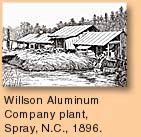
to make aluminum, Canadian inventor Thomas L. Willson (1860-1915) accidentally discovered the electric-arc process for preparing calcium carbide, which reacts with water to form acetylene. The first commercial calcium carbide plant, built by local entrepreneur James Turner Morehead (1840-1908), operated here between 1894 and 1896. From this beginning, calcium carbide manufacturing spread around the world. Acetylene, used first for lighting homes, railways, mines, and marine buoys and then for oxyacetylene welding, became one of the foundations of the synthetic organic chemicals industry.
Industrial Processes Discovered By Chance
May 2, 1998, marked the 106th anniversary of an unexpected discovery in the village of Spray (now Eden), North Carolina, that proved to be a milestone in the history of the chemical industry. On that date, Thomas L. Willson, a struggling young Canadian inventor, accidentally discovered the processes for making calcium carbide and acetylene in commercial quantities.
Acetylene, when burned in air, gave a light far brighter than any in use at the time for home lighting. When burned with oxygen, it gave a flame that was 1000 °C hotter than any other, leading to the development of commercial oxyacetylene welding and cutting. Most importantly, acetylene later became the starting material in the synthesis of hundreds of aliphatic organic chemicals used worldwide, particularly solvents, plastics, and synthetic rubber.
Thomas Leopold Willson (1860-1915), discoverer of these processes, was born in Princeton, Ontario, the grandson of John Willson, speaker of the United Canadian Assembly. He attended Hamilton Collegiate Institute; but after his father died, he withdrew from school to develop an arc-lighting system, the first seen at Hamilton. At age 22, he moved to the United States where he held various jobs in the mechanical and electrical trades before settling in Brooklyn, New York, in 1887. His work over the next three years resulted in six patents, which secured for him the rights in the United States for use of the electric-arc furnace in ore smelting. Aluminum metal was a primary target.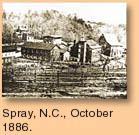
In December 1890, the Willson Aluminum Company was formed to exploit Willson's patents. In 1891, Willson moved to Spray to build a small 300-horsepower plant along the Smith River on land owned by one of the company's financial backers, James Turner Morehead (1840-1908). Morehead, a graduate of the University of North Carolina and a Confederate army veteran, was a textile manufacturer, land and water power developer, and former state senator. Although most of Morehead's business ventures prospered, failure of a railroad in which he had invested left him deeply in debt. To raise cash, he looked for new uses for his abundant supply of water power. This search led him to Willson.
Thomas Willson was just one among many seeking an economical way to make aluminum. His approach was to reduce the aluminum ore with carbon in a high-temperature, electric-arc furnace, a process explored in the laboratory at about the same time by the French chemist Henri Moissan.
In practice, Willson was able to produce only a few globules of aluminum. He then reasoned that if he could make a more chemically active metal, such as calcium, he could, in turn, use the calcium to reduce alumina. Accordingly, on May 2, 1892, a mixture of lime (calcium oxide) and coal tar (carbon) was subjected to the heat of the arc. When the furnace was tapped and the resulting product thrown into water, it produced a flammable gas thought to be hydrogen, as was expected from calcium. 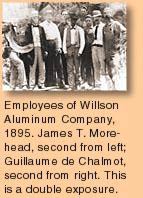
However, unlike clean-burning hydrogen, this gas burned with a sooty flame, for which there was no ready explanation. Willson then retained Francis P. Venable (1856-1954), of the University of North Carolina, as a consultant. During the summer and fall of 1892, Venable proved that the furnace product was calcium carbide and that the gas as it evolved with water was acetylene, a reaction identified in 1862 by the German chemist Friedrich Wöhler. Although there were no uses for either calcium carbide or acetylene at the time, Willson filed for a patent on this process on August 9, 1892.
Meanwhile, the experimental work to make aluminum continued. By the spring of 1893, however, it was obvious that Willson's process was a failure. The stock market crash in May 1893 and the ensuing depression bankrupted the company, leaving Morehead virtually penniless.
Failing to find anyone willing to buy their calcium carbide and acetylene patents, Morehead and Willson turned their attention to finding and promoting uses for the products themselves, beginning with acetylene in lighting. After they showed that acetylene could produce a flame 10 to 12 times brighter than that of coal gas, its use as an illuminant developed rapidly. Willson made the first sale of calcium carbide, 1 ton, to Eimer and Amend, a New York chemical and apparatus supply house, on January 29, 1894. Fortune smiled again when, in August 1894, they sold their patents for the use of carbide and acetylene in lighting to a new firm, the Electrogas Company, but retained the rights for chemical manufacturing. Electrogas Company, in turn, began to sell carbide manufacturing rights worldwide. As part of the agreement, Willson reserved all rights for Canada, and Morehead bought a manufacturing franchise.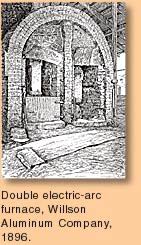
Willson moved back to New York in the fall of 1893 and set up a laboratory at Eimer and Amend to explore chemical uses for acetylene. After making small quantities of chloroform and aldehydes, he filed for a patent in February 1894 to cover the use of acetylene in the manufacture of "hydrocarbon products."
By borrowing more money, Morehead was able, in August 1894, to complete at Spray the first commercial calcium carbide plant. Its 8-foot high, double-sided furnace was capable of continuous operation. While a charge of lime and tar was being processed on one side, a completed run of carbide could be cooling on the other. The furnace produced 1 ton of carbide every 24 hours, which yielded 4.8 cubic feet of gas per pound, 80% of the theoretical. As publicity about acetylene's possibilities soared, so did the demand for carbide. On May 1, 1895, the plant began to operate around the clock. The months that followed were giddy with success, but then disaster struck; the Willson plant was destroyed by fire on March 29, 1896.
Morehead built a much larger plant on the James River near Lynchburg, Virginia. Almost simultaneously, he opened a plant at Kanawha Falls, West Virginia, to make ferro-alloys, processes that had been developed at Spray by Willson and Guillaume de Chalmot (1870-1899), the plant superintendent. Eventually, Morehead sold his holdings to the Union Carbide Company, which had been formed in 1898 to consolidate the interests of the Electrogas Company. He paid off his debts and, at his death, left an estate of $200,000.
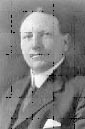 Willson returned to Canada in 1895, where he became one of its wealthiest and best-known citizens. By 1896, he was constructing a carbide plant at Merritton, Ontario, and later he built plants in Ottawa and Shawinigan Falls. As he sold rights for carbide manufacture to others, he developed many interests, forming new companies and plants as he proceeded to produce hydroelectric power, acetylene-lighted marine buoys, fertilizer, cement, ammonia, phosphoric acid, and paper. He sold his marine buoy business in 1909 and his interests in carbide manufacture to a new firm, Canada Carbide Company, formed in 1911. He died of a heart attack in New York while raising money for yet another project. His home in Woodstock, Ontario, is now a national historic site, and his summer home on Meech Lake in Quebec is a government conference center and retreat.
Vertaling door Google Translate
Acetyleen, toen verbrand in de lucht, heeft een lichte veel helderder dan in gebruik op het moment dat voor de verlichting in huis. Bij verbranding met zuurstof, gaf een vlam die 1000 ° C warmer dan alle andere was, leidt tot de ontwikkeling van commerciële autogeen lassen en snijden. Belangrijker, acetyleen werd later het uitgangsmateriaal bij de synthese van honderden alifatische organische chemicaliën wereldwijd gebruikt, in het bijzonder oplosmiddelen, kunststoffen en synthetische rubber.
Thomas Leopold Willson (1860-1915), de ontdekker van deze processen, werd geboren in Princeton, Ontario, de kleinzoon van John Willson, spreker van de Verenigde Canadese Vergadering. Hij woonde Hamilton Collegiate Institute; maar nadat zijn vader overleed, trok hij van school naar een boog-verlichting, de eerste zien op Hamilton ontwikkelen. Op de leeftijd van 22, verhuisde hij naar de Verenigde Staten waar hij verschillende banen in de mechanische en elektrische trades voordat hij zich in Brooklyn, New York, in 1887. Zijn werk de komende drie jaar resulteerde in zes patenten, die beveiligd voor hem de rechten in de Verenigde Staten voor het gebruik van de elektrische vlamboogoven in erts smelten. Aluminium was een primaire doelgroep.
In december 1890 werd de Willson Aluminum Company opgericht om Willson's patenten te exploiteren. In 1891, Willson verplaatst naar Spray een kleine 300 pk fabriek langs de rivier Smith bouwen op grond die eigendom is van een van de geldschieters van het bedrijf, James Turner Morehead (1840-1908). Morehead, afgestudeerd aan de Universiteit van North Carolina en een Verbonden leger veteraan, was een textielfabrikant, land en water stroom ontwikkelaar, en oud-senator. Hoewel de meeste van Morehead's zakelijke ondernemingen voorspoedig, het falen van een spoorlijn, waarin hij had geïnvesteerd liet hem diep in de schulden. Om geld op te halen, zocht hij naar nieuwe toepassingen voor zijn overvloedig aanbod van waterkracht. Deze zoektocht leidde hem naar Willson.
Thomas Willson was gewoon een van de vele op zoek naar een goedkope manier om aluminium te maken. Zijn benadering was om de aluminium erts met koolstof te verminderen in een hoge temperatuur, elektrische vlamboogoven, een proces onderzocht in het laboratorium op ongeveer hetzelfde moment door de Franse chemicus Henri Moissan.
In de praktijk Willson kon slechts enkele bolletjes aluminium te produceren. Hij redeneerde dat als hij een chemisch actieve metalen kunnen maken, zoals calcium, hij zou op zijn beurt gebruikt om alumina calcium verminderen. Dienovereenkomstig, op 2 mei, 1892, een mengsel van kalk (calciumoxide) en koolteer (koolstof) werd onderworpen aan de hitte van de boog. Toen de oven werd afgetapt en de resulterende product geworpen water, produceerde een brandbaar gas gedacht waterstof, zoals werd verwacht van calcium.
Echter, in tegenstelling tot schoon brandende waterstof, dit gas verbrand met een roet vlam, waarvoor er was geen pasklare verklaring. Willson dan behield Francis P. Venable (1856-1954), van de Universiteit van North Carolina, als consultant. Tijdens de zomer en herfst van 1892, Venable bewezen dat de oven product was calciumcarbide en dat het gas als het geëvolueerd met water was acetyleen, een reactie die in 1862 door de Duitse chemicus Friedrich Wöhler. Hoewel er geen gebruik voor zowel calciumcarbide of acetyleen op het moment, Willson ingediend voor een octrooi op dit proces op 9 augustus 1892.
Ondertussen, het experimentele werk om aluminium te maken voortgezet. In het voorjaar van 1893, maar het was duidelijk dat Willson het proces was een mislukking. De beurscrash mei 1893 en de daaruit voortvloeiende depressie failliet van het bedrijf, waardoor Morehead vrijwel berooid.
Niet om iedereen die bereid is om hun calciumcarbide en acetyleen patenten kopen te vinden, Morehead en Willson richtten hun aandacht op het vinden van en het bevorderen van het gebruik van de producten zelf, te beginnen met acetyleen in verlichting. Nadat ze toonden aan dat acetyleen vlam 10 om 12 keer helderder dan die van kool kon produceren, het gebruik ervan als lichtbron snel ontwikkeld. Willson maakte de eerste verkoop van calciumcarbide, 1 ton, om Eimer en wijzigen, een in New York chemische en apparatuur aanbod huis, op 29 januari, 1894. Fortune glimlachte weer toen, in augustus 1894, zij verkochten hun patenten voor het gebruik van hardmetalen en acetyleen in de verlichting van een nieuwe onderneming, de Electrogas Vennootschap, maar behield de rechten voor de chemische industrie. Electrogas Company, op zijn beurt, begon carbide productie rechten wereldwijd verkopen. Als onderdeel van de overeenkomst, Willson voorbehouden alle rechten voor Canada, en Morehead kocht een productie-franchise.
Willson verhuisde terug naar New York in de herfst van 1893 en het opzetten van een laboratorium in Eimer en wijzigen om te verkennen chemische toepassingen voor acetyleen. Na het maken van kleine hoeveelheden chloroform en aldehyden, diende hij een patent in februari 1894 het gebruik van acetyleen bij de vervaardiging van dekking "koolwaterstofproducten."
Door geld te lenen meer geld, Morehead was in staat, in augustus 1894, in te vullen bij Spray de eerste commerciële calciumcarbide plant. De 8-voet hoog, dubbelzijdige oven was in staat om continue werking. Terwijl een last van kalk en teer werd verwerkt aan de ene kant, zou een voltooide run van carbide worden koeling op de andere. De oven produceerde 1 ton van carbide elke 24 uur, waarvan 4,8 kubieke voet gas per pond, 80% van de theoretische opgeleverd. Publiciteit over de mogelijkheden acetyleen is gestegen, zo ook de vraag naar carbide. Op 1 mei 1895, de plant begon te werken de klok rond. De maanden die volgden waren duizelig met succes, maar vervolgens ramp getroffen; de Willson fabriek werd verwoest door een brand op 29 maart 1896.
Morehead bouwde een veel grotere installatie op de James River in de buurt van Lynchburg, Virginia. Bijna gelijktijdig, een fabriek opende hij in Kanawha Falls, West Virginia, om ferro-legeringen te maken, processen die op Spray had ontwikkeld door Willson en Guillaume de Chalmot (1870-1899), de plant superintendent. Uiteindelijk Morehead verkocht zijn participaties aan de Union Carbide Company, die werd opgericht in 1898 om de belangen van de Electrogas Company consolideren. Hij afbetaald zijn schulden en, bij zijn dood, liet een landgoed van $ 200.000.
Willson keerde terug naar Canada in 1895, waar hij een van de rijkste en meest bekende burgers. Door 1896, werd hij de bouw van een fabriek in carbide Merritton, Ontario, en later bouwde hij planten in Ottawa en Shawinigan Falls. Zoals hij verkocht de rechten voor carbide productie aan anderen, ontwikkelde hij veel belangen, de vorming van nieuwe bedrijven en planten zoals hij overgegaan tot waterkracht, acetyleen-verlichte marine boeien, kunstmest, cement, ammoniak, fosforzuur, en papier te produceren. Hij verkocht zijn mariene boei in 1909 en zijn belangen in carbide vervaardigen van een nieuwe onderneming, Canada Carbide Company, opgericht in 1911. Hij stierf aan een hartaanval in New York terwijl het inzamelen van geld voor nog een ander project. Zijn huis in Woodstock, Ontario, is nu een nationale historische plaats, en zijn zomerhuis op Meech Lake in Quebec is een regering conferentiecentrum en retraite.
And in Englisch
Op deze site op 2 mei 1892, terwijl het zoeken naar een economisch proces om aluminium te maken, de Canadese uitvinder Thomas L. Willson (1860-1915) bij toeval ontdekt de elektrische boog proces voor het bereiden van calciumcarbide, die reageert met water acetyleen te vormen. De eerste commerciële calciumcarbide fabriek, gebouwd door de plaatselijke ondernemer James Turner Morehead (1840-1908), geëxploiteerd hier tussen 1894 en 1896. Van dit begin, calciumcarbide productie verspreid over de hele wereld. Acetyleen, wordt gebruikt voor de verlichting van de eerste huizen, spoorwegen, mijnen, en maritieme boeien en vervolgens voor autogeen lassen, werd een van de fundamenten van de synthetische organische chemie Industrial Proces bij toeval ontdekt.
2 mei 1998, was het 106-jarig bestaan van een onverwachte ontdekking in het dorp Spray (nu Eden), North Carolina, dat bleek een mijlpaal in de geschiedenis van de chemische industrie. Op die datum, Thomas L. Willson, een worstelende jonge Canadese uitvinder, bij toeval ontdekt de processen voor het maken van calciumcarbide en acetyleen in commerciële hoeveelheden.



© 2001-2018 Carbidbus.nl
Carbidbus
Mandewijk 3
9243 JW Bakkeveen
E-mail
info@carbidbus.nl
